
Not all horse bells are crotals (sleigh bells.) Sometimes open-mouth (or open) bells were worn by horses as well. The ones used on horses usually have a circular cross section, like the classic "liberty" or church bell.
Bells that are square or rectangular in cross section can certainly be used on horses, but are more often worn by cattle, sheep or goats. Open bells for horses usually do not have any special inscriptions or other markings, with the exception of some streetcar or trolley bells.
Sometimes loose open-mouth bells are mistakenly called "Conestoga" bells. Loose open-mouth bells are just that -- loose bells. Real Conestoga bells are open bells attached to a metal bracket that arches above the collar of a draft horse.
In general, open bells from 3/4 to 1 inch are usually found on English swingers and harness drops. Bells 1 1/2 to 3 inches in diameter are often used on neck and body straps; hame and Conestoga bell sets; and saddle, pole and shaft bell sets. A single large open bell on a neck strap would typically be worn by a pack or draft horse. Bells larger than about 5 inches do not appear to have been used much, if at all, on horses.
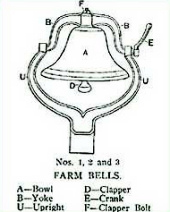
An open bell is sounded when one or more clappers hanging inside or outside the bell strike the surface of the bell. A bell with two or more clappers is called a chime. The place where the clapper strikes the classic tulip-shaped open-mouth bell is called the sound bow. Other parts are identified in the old catalog illustration shown below.
Open bells can be cast, stamped, or spun from any kind of metal, but the best bells are cast from brass or bell bronze. For more about the art of making these bells, I recommend the section on "founding bells" at the Blagovest Bells website.
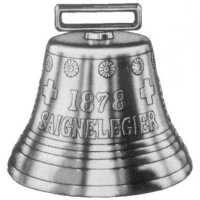
These open-mouth bells are often found on the collectibles market, in eight sizes ranging from 2 3/4" to 6" in diameter. They are sometimes called Swiss cow bells, although they can be used on any animal, including cattle, horses, sheep and goats.
I have not found any reputable bell historian who can provide an accurate history of the Saignelegier bell design. Because of this, I am extremely skeptical of the many fanciful stories told about the origins of this bell design.
What I do know for certain is that Bevin Bros. Mfg. Co. of East Hampton, Connecticut USA, has made these bells for many decades. According to the Bevin sales brochure:
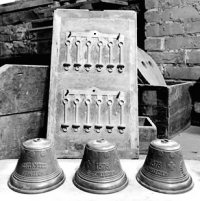
"These Swiss cow and sheep bell reproductions are hand cast from mold patterns found in the Bevin Bros. factory almost 100 years ago. Each bell is cast from bronze in the pattern of the famous 1878 Saignelegier bell, which, legend tells, comes form the town of the same name.
"Today our Swiss bells are still used around the farm. Their delightful tone and appearance, however, make them ideal decorative accessories. No two bells are exactly alike in appearance or tone."
Swiss cow bells that are genuinely old cannot easily be distinguished from new ones, especially since many new bells have been artificially antiqued to increase their apparent worth as an "instant antique."
Whether apparently old or obviously newer, Saignelegier bells are also very common on the collectibles market. I would value these bells at the current retail price for new Saignelegier bells, depending on size.
Photo, top: Saignelegier cow bell from a Bevin Bros. Mfg. Co. sales brochure.
Photo, middle: Parts for Saignelegier bells in the Bevin foundry. Photo dated 1979.
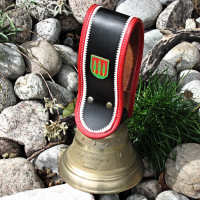
Photo, bottom: Modern cow bells are sold as souvenirs. This one has a short neck strap meant for display.
Copyright © 2002-2025 - All rights reserved by Classic Bells Ltd.
Template by OS-templates.com
