
By about 1870, machines were developed to stamp sheet brass into bells. The process is faster than hand casting, and less brass is used per bell. Both of these factors greatly reduced manufacturing costs. The downside of machine stamping is that most types of stamped bells are more fragile than their cast cousins.
The process allowed designers to create bells that would be difficult to make with the more traditional casting process, so some sleigh bell designs exist only in this type of bell. Stamped bells generally have a lighter, higher sound than cast bells of the same diameter. The sound is a distinctive bright "waterfall" sound or a liquid "shimmery" tone.
Some bells were stamped from one piece of sheet brass. The patent bell (also called a Tucker bell) is an example. Most stamped bells, including the stamped egg, band, and beehive bells, were formed from two pieces of lightweight brass crimped together in the middle.
Almost all stamped brass bells are all fairly small -- no more than 1 3/8 inch in diameter. Lightweight sheet brass is not rigid enough to be formed into bells much larger than this. One exception to this is the sturdy "improved Swedish" bell that can be as large as 3 inches in diameter. Many stamped bells were plated with nickel or chrome. Most of the original makers attached stamped bells to a strap with copper or mild steel rivets, although maker W.E. Barton used screws. More about rivet-style bells...
Stamped bells were often attached to a dark leather strap about 1 inch wide. The bells were spaced 1 3/8 to 2 1/2 inches apart. Some manufacturers mounted stamped "egg" bells on a flexible metal "Sunday" strap made of small brass plates connected with oblong wire links.
Some leather straps were edged or lined with one or more layers of thin leather -- or possibly an oilcloth textured to look like leather. Edging material was sometimes cut with a pinking machine. When sewn to a bell strap, this pinked edging created an attractive zig-zag border along the strap. The color of the decorative edging or lining varied from sedate browns or black to bold shades of red, white, green and yellow.
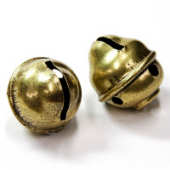
Left: Two-piece stamped egg bells, 1 1/4" and 1 1/2" diameter. These light-weight brass bells were also called "Dexter" bells. They were often plated with silvery nickel.
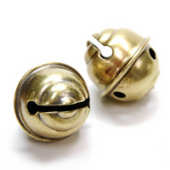
Middle: Beehive bells are a two-piece lightweight bell made of sheet brass. They are popular with Native American dancers for their unique shape and sound.
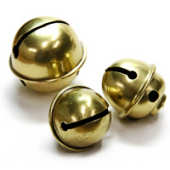
Right: Stamped "pear" bells made of lightweight sheet brass in two pieces.
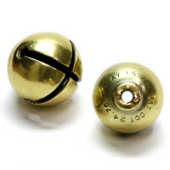
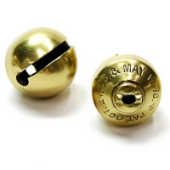
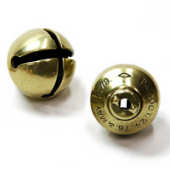
One-piece patent or Tucker bells designed by George Tucker of Waterbury, Connecticut. More about George Tucker...
Left: The most common style has two throats (slits) and a conical base. The base is circled with the dates of Tucker's patents.
Middle: This version has the same shape as the common style, but only one throat.
Right: Spherical Tucker bells were produced through the early-to-mid 1900s. Later versions of this style were not marked with the patent dates.
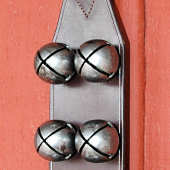
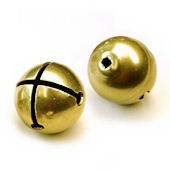
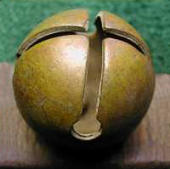
Left and Middle: Descendants of the Tucker bells, these vintage jingle or arctic bells were made of sheet brass. Many were originally plated with nickel to give the bells a silver color. These bells are spherical and have no markings.
Right: Modern jingle or arctic bells are made of sheet steel. These bells are usually plated with a thin protective layer of brass or nickel to add color, shine, and a bit of rust protection.
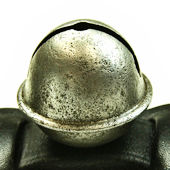
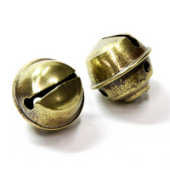
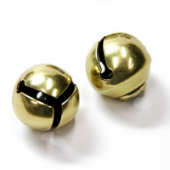
Left: Delicate
one-piece brass "triple throat" bells possibly designed by George Tucker. These bells were made from either sheet steel or sheet brass.
Middle: Stamped "band" bells made of sheet brass, originally nickel plated.
Right: This vintage steel "Dexter" bell from the mid 1900s was originally nickel or chrome plated. This lightweight, sturdy bell was made in several sizes ranging from 1 1/4" diameter (shown) to 2 1/2".
Copyright © 2002-2025 - All rights reserved by Classic Bells Ltd.
Template by OS-templates.com
